










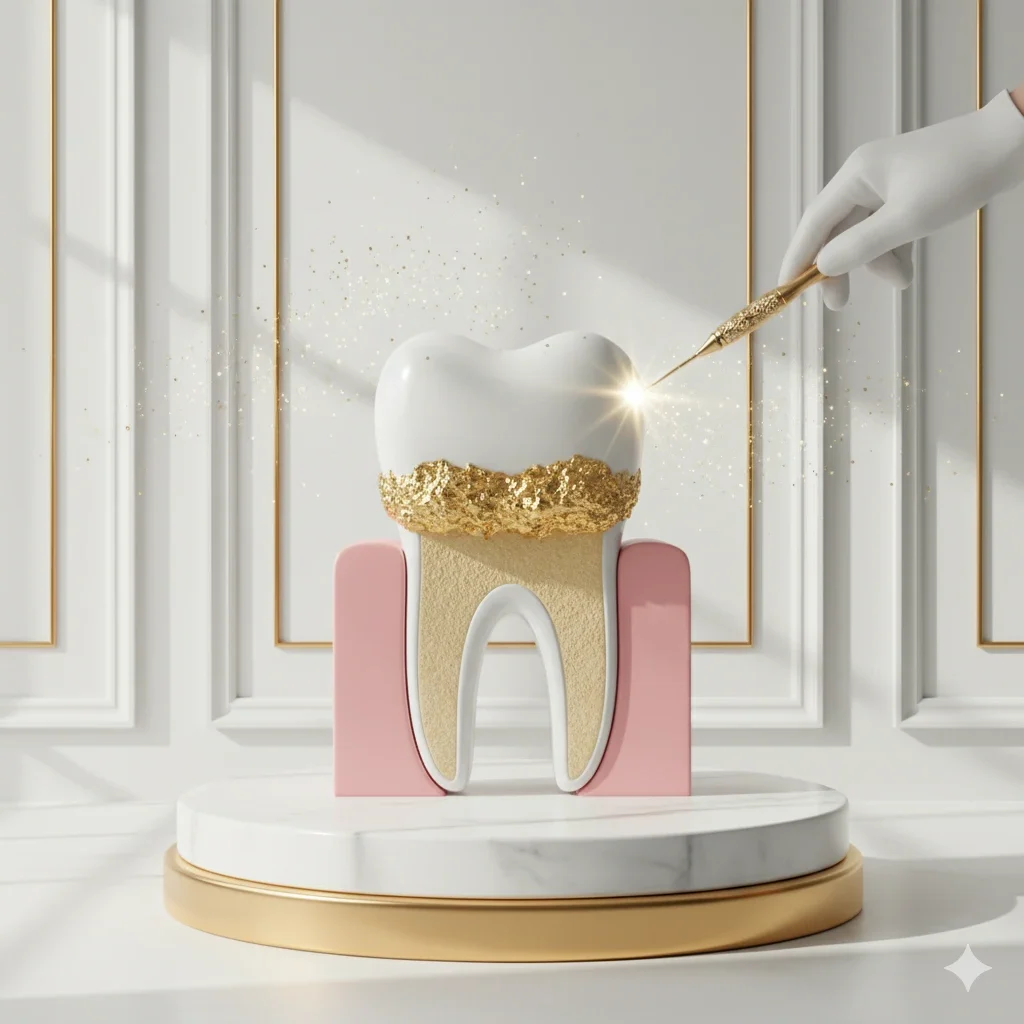
Periodontics is a branch of science that aims to protect the health of tissues surrounding the teeth, such as gums, alveolar bone, periodontal ligament and cementum, and to treat their diseases.
Gum health is a critical element not only for an aesthetic smile but also for healthy chewing, a bad breath-free social life, and systemic health.
Valinor Dental Clinic'’te Periodontics is applied from a holistic perspective with preventive approaches, advanced surgeries and aesthetic solutions.
1) Periodontal Health and Preventive Approach
- Scaling: Cleaning of plaque and tartar with ultrasonic devices.
- Root planing: Smoothing the subgingival surfaces.
- Plaque control education: Brushing techniques, interdental cleaning, oral irrigator.
- Periodic check-ups: Follow-up at 3–6 month intervals.
2) Gum Diseases
Gingivitis (Inflammation of the Gum)
- Symptoms: Red, swollen, bleeding gums.
- Treatment: Professional cleaning + oral hygiene education.
- It is reversible.
Periodontitis (Gingivitis – Advanced)
- Symptoms: Gum recession, pocket formation, mobility, bad breath.
- Treatment: Deep curettage, local antibacterial agents, surgery if necessary.
- Notes: It damages the bone and connective tissue.
3) Advanced Periodontal Treatments
- Flap surgery: Cleaning the pocket by lifting the gums.
- Regenerative surgery: Tissue regeneration with bone graft + membrane.
- Resective surgery: Bone and gum shaping.
- Laser-assisted periodontal treatments: Bleed-free, rapid healing.
4) Aesthetic Periodontal Treatments
- Treatment of gum recession (Recession surgery): Free gum graft or connective tissue graft.
- Gummy smile treatment: Correction of excess gum visibility with surgery or laser.
- Papilla reconstruction: Closure of black triangles.
- Symmetry & contour adjustments: Periodontal dimension of smile design.
5) Treatments around the Implant
- Peri-implant mucositis: Peri-implant surface cleaning, plaque control.
- Peri-implantitis: Bone loss + infection; surgery + regenerative approaches.
- Regular maintenance: Essential for the long life of implants.
6) Periodontal–Systemic Relationship
- Periodontal diseases are linked to cardiovascular diseases, diabetes, premature birth, and respiratory infections.
- At Valinor, periodontal treatment is considered integrated with whole body health.
7) Valinor Dental Clinic Difference
- Digital diagnosis: Intraoral scanning, bone support analysis with CBCT.
- Minimally invasive surgeries: Microscope & laser-assisted applications.
- Regenerative materials: Tissue recovery with biocompatible grafts and membranes.
- Aesthetic-focused approach: Integration of health + smile design.
- Multidisciplinary collaboration: Coordinated with orthodontics, implantology and prosthetic treatment.
Periodontics — Frequently Asked Questions
1) What is periodontics?
Periodontics deals with the diagnosis and treatment of diseases of the tissues that support the teeth (gums, periodontal ligament, alveolar bone, and cementum). The goal is to maintain healthy teeth and jawbone attachment and prevent inflammation and bone loss.
2) Why do gum diseases occur?
The main cause is bacterial plaque. Inadequate brushing/interdental cleaning, smoking, stress, genetic predisposition, diabetes Systemic conditions such as and poor prosthesis/coating fit increase the risk.
3) What is the difference between gingivitis and periodontitis?
Gingivitis is merely superficial inflammation of the gums and is reversible. Periodontitis, on the other hand, is when the inflammation spreads beneath the gums and destroys connective tissue and bone, leading to tooth loss if left untreated.
4) Is gum disease contagious?
It is not directly classified as an "infectious disease," but bacteria in the oral flora can be transmitted through close contact. The primary determining factors are personal hygiene and immune response.
5) Is bad breath (halitosis) always due to gum disease?
The cause is often bacterial plaque. However, there may also be other causes such as tonsil stones, sinus problems, gastric reflux, and dry mouth. Periodontal treatment significantly reduces bad breath.
6) What symptoms suggest gum disease?
Bleeding (while brushing/flossing), swollen and red gums, bad breath, receding gums, sensitivity to hot and cold, loose teeth, and discomfort when biting.
7) What is done during a periodontal examination?
Pocket depth measurement (mm measurement with probe), bleeding index, mobility (sway) assessment, plate level, radiographs and, if necessary, bone status are analyzed with CBCT.
8) What does “periodontal pocket” mean?
The healthy sulcus between the tooth and gum is normally 1–3 mm. If this area deepens due to inflammation and ligament destruction, a periodontal pocket forms, increasing bacterial accumulation and damage.
9) Is x-ray necessary?
Yes. Seeing the bone level is essential to detect "missing" bone defects. Low-dose digital X-rays are used.
10) Is CBCT (3D imaging) necessary for every patient?
No. It is used selectively for advanced bone defects, implant planning, or anatomical doubts.
C) Gingivitis (Inflammation of the Gum)
11) Does gingivitis completely disappear with treatment?
Yes. With professional cleaning (scaling) + proper brushing/interdental cleaning, it usually resolves within 2–4 weeks.
12) Does gargling salt water at home work?
It may provide temporary relief; however, it is not a permanent solution unless plaque/tartar is professionally removed.
13) Does gum bleeding increase during pregnancy?
Yes. Hormonal changes make gums sensitive. Regular care and cleaning are effective in controlling pregnancy gingivitis.
14) Can children get gingivitis?
It happens. It can be prevented with proper brushing training, fissure sealants, and regular checkups.
15) Is using only mouthwash enough?
No. Mechanical cleaning (brush + interdental) is essential; gargling is only supportive.
D) Periodontitis (Advanced Gum Disease)
16) Does periodontitis return?
Destroyed ligaments and bone don't grow back on their own; however, the disease can be stopped with treatment and maintained stable with proper care. In some cases, tissue recovery through regenerative surgery is possible.
17) What is deep cleaning (root planing)?
It involves cleaning the stone and bacterial biofilm under the gum with special curettes and ultrasonic devices and smoothing the root surface.
18) Is deep cleaning painful?
It is performed comfortably under local anesthesia. There may be mild tingling for 1-2 days afterward.
19) Are antibiotics necessary?
No in routine cases. Only indicated in cases of acute infection/abscess, systemic findings or specific types of aggressive periodontitis.
20) Does periodontitis definitely lead to tooth loss?
No. With early diagnosis, effective treatment and regular care, teeth can be protected for many years.
E) Surgical Treatments
21) What is flap surgery?
The gums are lifted in a controlled manner to access the tooth root and bone surfaces; deep pockets are cleaned, surfaces are smoothed, bone shaping is performed if necessary, and the tissue is re-sealed.
22) What does regenerative surgery provide?
Special bone grafts and membranes aim to regenerate natural tissues in certain bone defects.
23) When is resective surgery performed?
It is used to correct the contour and ease maintenance of irregular bone edges and deep, inaccessible pockets.
24) Is laser useful in periodontics?
Laser can help reduce bleeding, aid disinfection, and accelerate healing. It's not a miracle cure on its own, nor is it a substitute for mechanical treatment.
25) How long is the recovery period after surgery?
Usually 7–14 days. Stitches are removed on days 7–10. Full tissue maturation takes longer; controll appointments is planned.
F) Aesthetic Periodontal Procedures
26) How is Gummy Smile (too much gum visibility) treated?
Depends on the reason:
- Diş if there is excess flesh, gingivectomy/gingivoplasty
- Botulinum toxin support due to lip movement
- If it is due to tooth-bone relationship, crown lengthening/surgical adjustment.
27) What causes gum recession?
Overly hard brushing, incorrect technique, thin biotype, traumatic occlusion, orthodontic factors and periodontitis may lead to recession.
28) What is connective tissue grafting in the treatment of recession?
Connective tissue taken from the palate is transplanted to the relevant area to cover the root surface, reduce sensitivity and provide aesthetic symmetry.
29) Do black triangles (papilla loss) close?
In mild to moderate loss, recovery is possible with papillary reconstruction or restorative support (contact area adjustment). Advanced loss requires combined solutions.
30) What is the effect of gum symmetry on smile aesthetics?
The alignment, level, and curvature of the gum margins determine the symmetry of the smile. In smile design, the pink aesthetic (gums) and the white aesthetic (teeth) are planned together.
G) Implant Surrounding Health
31) What is peri-implant mucositis?
This is an inflammation of the soft tissue around the implant; bleeding and redness occur, but there is no bone destruction. With early intervention, it can be completely resolved.
32) What is peri-implantitis?
The infection has progressed to bone loss. Treatment includes mechanical and chemical cleaning, laser support, and, if necessary, surgical and regenerative approaches.
33) Why does the area around the implant become inflamed?
Inadequate hygiene, smoking, diabetes, poor biotype, faulty prosthesis design and irregular check-ups are important risks.
34) Does peri-implantitis mean implant loss?
If caught early, it can be prevented. The risk of failure increases with advanced bone loss; a personalized plan is developed.
35) I have an implant; how often should I have it maintained?
Generally, professional maintenance and careful interface cleaning at home are essential every 3–6 months.
H) Systemic Relations
36) Does periodontitis affect cardiovascular health?
Yes. It is associated with cardiovascular risk by increasing systemic inflammation. Treatment and care reduce systemic burden.
37) What is the bidirectional relationship between diabetes and periodontitis?
Diabetes exacerbates periodontal disease, and periodontitis complicates glycemic control. Treating one positively impacts the other.
38) Is periodontal treatment safe during pregnancy?
Professional cleanings and necessary treatments are safe with a doctor's prescription. The second trimester is ideal. Oral health can affect the risk of premature birth and low birth weight.
39) Why does smoking complicate treatment?
It reduces blood flow, weakens immunity, delays healing, and reduces the chance of surgical success.
40) Does stress affect periodontal disease?
Yes. It can suppress immunity and worsen habits (squeezing, poor hygiene).
I) Post-Procedure and Care
41) How can I feel after deep cleaning?
Sensitivity and stinging to hot and cold are normal for 1–2 days. Warm salt water, along with the recommended painkillers and desensitizing gels, may provide relief.
42) How should nutrition be after surgery?
For the first 24–48 hours, eat warm, soft foods and avoid hot and spicy foods. Do not use a straw or force the surgical site.
43) When are stitches removed?
Dissolvable stitches may fall out on their own, usually within 7–10 days.
44) What should I pay attention to in home care?
The right brush, soft-bristled choice, interdental brush/dental floss, oral irrigator if necessary, mouthwash recommended by the dentist and regular check-ups.
45) Post-treatment control intervals?
3–6 months, depending on your risk. 6 months is appropriate for stable patients, and 3–4 months is appropriate for high-risk patients.
J) Orthodontics–Prosthetics–Aesthetic Integration
46) Does orthodontics increase gum recession?
In thin bone areas, rapid/incorrect movement may increase recession. Valinor orthodontics periodontal is planned through analysis.
47) Do veneers/crowns affect the gums?
Overhanging edges increase plaque accumulation. We design with respect for biological width and gingival contour.
48) Why is “pink aesthetics” critical in smile design?
Gum contour and symmetry are the basis for the form-color harmony of teeth.–gums are planned together.
49) What is crown lengthening?
It is a surgery that makes the crown part of the tooth visible by adjusting the gum-bone level; it provides aesthetic and restorative space.
50) Can implants and aesthetic gum surgery be performed together?
Yes. Combined planning is applied for natural papilla and gingival architecture.
K) Frequently Asked Practical Questions
51) I have bleeding gums; is there an instant solution?
Temporary pressure and cold water are helpful, but there is no permanent solution without professional cleaning.
52) I noticed bleeding while brushing, should I stop brushing?
No. Bleeding is a sign of infection; you should continue brushing with correct technique and consult a physician.
53) Can gum recession reverse?
No, not spontaneously. Coverage and sensitivity reduction are possible with graft techniques.
54) I have sensitivity; is it my teeth or my gums?
It often results from the root surface being exposed by extraction. Desensitizing treatments and extraction surgery may be the solution.
55) Do teeth feel like they have “grown longer” after periodontal treatment?
Once the swollen gums subside and plaque and tartar are removed, the length of the teeth may become more visible. This is a sign of healing.
56) Does tartar always form again?
Yes, if plaque is inadequately controlled. It can be reduced with regular maintenance and proper technique.
57) Is the cleaning around implants different from normal teeth?
Yes. Special tips and interface accessories that do not corrode metal are used.
58) Would gargling alone be enough?
No. Mechanical cleaning (brush/interdental) is essential; mouthwash is supportive.
59) My gums have receded; how much can it be improved aesthetically?
Biotype, recession depth/width, and adjacent papilla status determine the outcome; an examination-based prediction is made.
60) What is the difference of Valinor in periodontics?
Root-cause-focused approach, microscopic and laser-assisted minimally invasive techniques, regenerative materials, and a balance between aesthetics and function. Plans are developed multidisciplinary.
Summary of Care Recommendations (Mini Guide to be Given to the Patient)
- 2 minutes twice a day, medium/soft bristle brush
- Daily interdental: Dental floss/interdental brush/oral irrigator
- Professional maintenance every 3–6 months
- Reduce smoking and excessive sugar and acid consumption
- Desensitizing products if there is sensitivity
- Personal training + special apparatus if orthodontics/implants/prosthetics are available
Valinor Dental Clinic'’Periodontics isn't just about "cleaning"; it's about maintaining health and aesthetically pleasing smile architecture. Our treatments are conducted with scientific protocols, advanced technology, and a refined patient experience.
Site contents are for informational purposes only and do not constitute advice.