





Correct diagnosis is a prerequisite for perfect treatment.
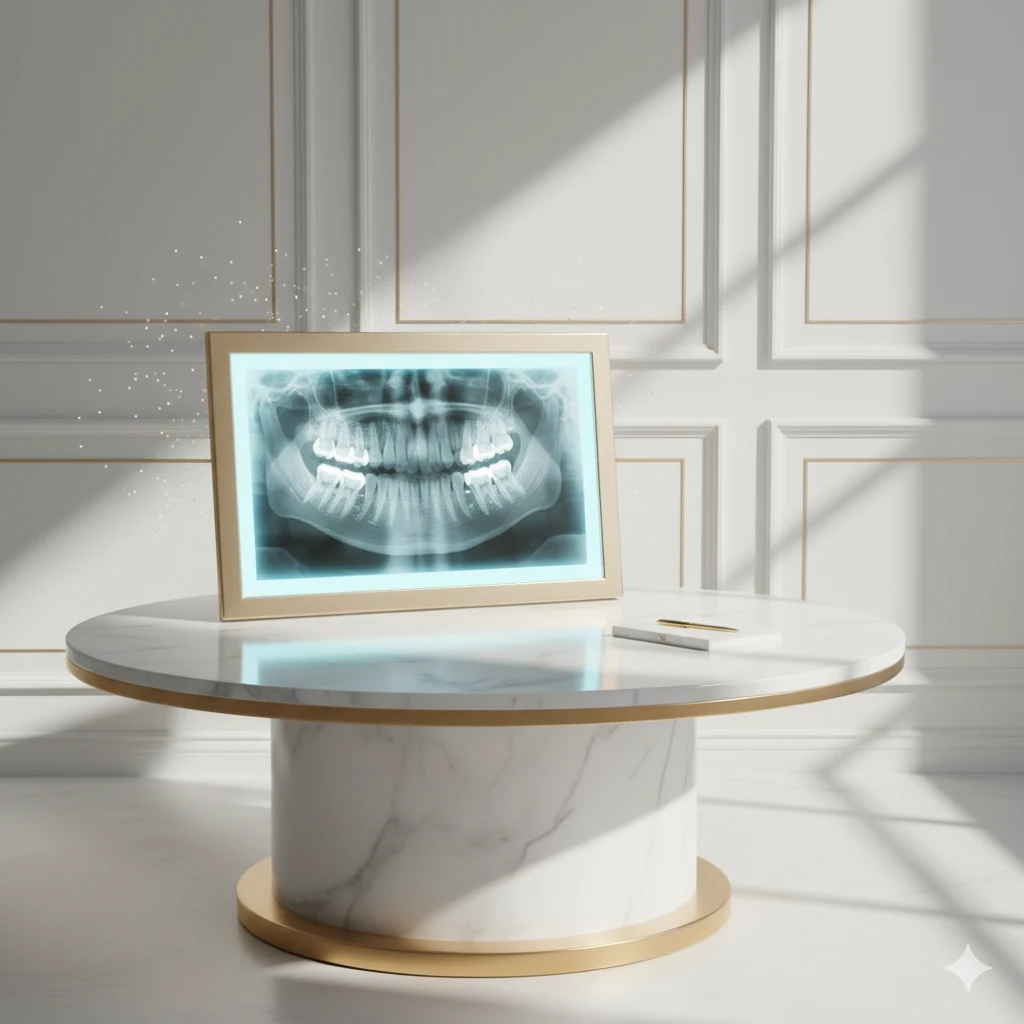
Valinor Dental Clinic’At , oral diagnosis and radiology are performed using our clinic's proprietary 3D full-head CBCT (wide FOV), 2D digital imaging (panoramic, cephalometric, periapical/bitewing, occlusal), intraoral camera (HD macro), and CBCT-based relative bone densitometry assessment. Our metric is clear: ALARA/ALADA — "the most information at the lowest dose.".
Hardware Inventory (Valinor's Diagnostic Devices)
1) 3D Full Head Cone Beam Computed Tomography (CBCT) – Wide FOV
Scope: Head–neck region, maxilla–mandible, paranasal sinuses, nasal cavity, TMJ (jaw joint), root–canal anatomy.
Key features:
- Multi-FOV (region-specific imaging to avoid unnecessary dose)
- Low dose protocols (adult/child)
- Metal Artifact Reduction (MAR)
- Fine voxel options (as per case requirement)
- MPR (multi-planar reconstruction), tilted panoramic reconstructions
- Measuring and marking tools (nerve canal, sinus floor, root tip, lesion margin)
Clinical use: Implant planning; impacted teeth; cyst/tumor suspicion; fracture–trauma; endo (extra canal/resorption/root fracture), peri (bone defect morphology), orthodontics (skeletal analysis, airway volume assessment), TMJ (condyle morphology and joint space).
2) 2D Digital Radiography Unit
- Panoramic (OPG): General scan—impacted teeth, bone-tooth relationship, sinus adjacency.
- Cephalometric (Lateral/PA): Orthodontic skeletal analysis, growth direction and treatment follow-up.
- Periapical & Bitewing (RVG sensors): Root ends, apical lesions, interface caries, restoration margins.
- Occlusal film: Large area calculus/calcification, supernumerary/impacted tooth positioning.
3) Intraoral Camera
Purpose: To show early signs such as caries, microcracks, abrasion, and old restoration leaks in close-up.
Benefit: Transparent communication and before-and-after documentation during the treatment decision-making process.
4) CBCT-Based Relative Bone Densitometry Assessment
- Note: Numerical densities obtained from CBCT are not absolute densitometry; they are used for relative quality interpretation.
- Use: Pre-implantation site comparison, supporting surgical strategy (in conjunction with clinical examination and surgical experience).
5) Radiation Safety and Software Ecosystem
- ALARA/ALADA: Indication-based injection, maximum protection in children.
- Protective equipment: Thyroid shield and lead apron are standard. Rectangular collimation/filtration reduces scatter.
- DICOM archive & reporting: KVKK-compliant secure storage; joint review by multidisciplinary team.
Clinical Workflow (From Diagnosis to Treatment)
- Indication & Anamnesis: Systemic risks (pregnancy, diabetes, anticoagulant, etc.) are reviewed.
- Targeted acquisition: 2D first; selective CBCT if no response.
- Image interpretation: Lesion margin, neighborhood, measurements, risk analysis.
- Diagnostic report: Visual presentation with the patient, together with the relevant specialist(s).
- Treatment plan & follow-up: Radiological findings → linked to clinical/prosthetic/surgical flow; control times are determined.
Protocols by Indication (Examples)
Implantology
- Before: Crest height/thickness, sinus floor, mandibular canal distances; adjacent teeth/stains.
- Plan: Measurements, angles, depths; need for graft/possible sinus intervention.
- After: Recovery and integration monitoring, control with CBCT in suspected cases.
Oral & Maxillofacial Surgery
- Impacted teeth: 3D location, root relationship (neighborhood with the nerve, especially in the lower 8s).
- Cyst/tumor suspicion: Lesion border, cortical destruction, adjacent organs.
- Trauma: Condyle/ramus/corpus/parasyphysis fracture line, displacement–rotation.
Endodontics
- Additional canal/root fracture/resorption: In case of suspicion, confirmation with 2D CBCT; decision for revision.
- Apical lesion: Margin, cortical perforation; follow-up healing.
Periodontics
- Vertical/muscular defect morphology: number of walls, craters, furcation level in 3D; regenerative plane.
- Peri-implant issues: Pattern of bone loss; monitoring of post-treatment healing.
Orthodontics & Airway & TMJ
- Cephalometry/CBCT: Asymmetry, skeletal pattern, airway volume (interpretation with clinical findings); condyle–fossa relationships, osteoarthritic change.
Pedodontics
- Eruption disorders & supernumerary teeth: Direction, close proximity, risk of resorption.
- Trauma: Root development, internal/external resorption monitoring (with indication).
Oral Pathology
- Sialoliths (salivary gland stones): Detection of radiopaque stones by CBCT/occlusal film.
- Sinus pathologies: Evaluation of odontogenic focus in suspected dental sinusitis.
Dose Management, Ethics and Quality
- No shots without indication.
- Pediatric protocols: Narrower FOV, lower mA–kV, shorter duration.
- Pregnancy: Postponed if not urgent; maximum protection and consultation if necessary.
- Quality assurance: Periodic calibration and inspection, standard reporting language.
- Transparency: Dosage and findings are shared with the patient; visual explanation is essential.
The Valinor Difference
- All advanced imaging infrastructure is within Valinor.
- Targeted shot protocols; no unnecessary doses.
- Specific diagnosis with MAR, MPR, multiple measurement tools.
- Multidisciplinary and report-oriented approach; visual and understandable communication with the patient.
Oral Diagnosis and Radiology — Frequently Asked Questions (FAQ)
A) General & Security
1) Is CBCT performed on every patient?
No. First, a response is sought with 2D; CBCT is performed only if indicated (ALARA/ALADA).
2) Is the radiation dose safe?
The dose is minimized according to the indication and site. In pediatric protocols, thyroid shielding and lead aprons are standard.
3) I'm pregnant—can I get the shot?
It is postponed except in emergencies. If necessary, a targeted scan is performed under gynecology and obstetrics consultation and maximum protection.
4) Is CBCT appropriate for my child?
CBCT is used very selectively in children. In most cases, 2D is sufficient.
5) Are repeated X-rays harmful?
Unnecessary repetition can be harmful; unnecessary repetition of the same problem is not allowed in Valinor—records are stored securely.
B) 2D – Panoramic / Cephalometric / Periapical / Bitewing
6) Does panoramic film show everything?
Ideal for general scanning, but periapical/bitewing or CBCT may be needed when detail is required.
7) Why is Bitewing important?
It shows the interface caries and filling-coating edges in close-up and provides early diagnosis.
8) What is the use of cephalometry?
Skeletal analysis in orthodontics is necessary for growth direction and profile evaluation.
9) When is periapical film?
Precise analysis of root tip and local lesions for endodontic follow-up.
10) Where is occlusal film used?
Large area stone/calcification, supernumerary teeth, impacted tooth orientation.
C) 3D – CBCT
11) How long does CBCT scan take?
Usually 10–20 seconds (a few minutes including preparation).
12) Is bone density measured in CBCT?
Relative quality assessment is made, not absolute measurement, and is interpreted together with surgical experience.
13) Will there be a metal artifact problem?
With MAR algorithms, artifacts are significantly reduced.
14) Do you perform airway analysis?
Yes, airway volume can be assessed on CBCT; it is always interpreted together with clinical findings.
15) Is CBCT sufficient for TMJ?
Yes for bone structures. MRI may be required for suspected disc/soft tissue abnormalities.
D) Implantology & Surgery
16) Why CBCT before implantation?
For nerve–sinus distances, crest height/thickness, possible graft requirement and safe angle–depth.
17) How is a sinus lift planned?
Base height, ostia/septums and adjacencies are measured in 3D; the surgical strategy is determined accordingly.
18) My impacted wisdom tooth is close to the nerve; what is done?
With CBCT, the relationship is clearly measured; risk management is done and alternatives are discussed.
19) Is CBCT sufficient in case of suspected cyst/tumor?
Borders and adjacencies are determined in 3D; pathology biopsy may be required for definitive diagnosis.
20) What do we see in trauma?
Fracture line, displacement, condyle–ramus–corpus–parasyphysis fractures and tooth root fractures.
E) Endodontics & Periodontics
21) Why sometimes 2D is not enough?
Additional canals, vertical root fractures, and resorptions can be hidden in 2D; they are shown three-dimensionally with CBCT.
22) How do you monitor apical lesion size?
Radiological healing is monitored with baseline and control CBCT/periapical comparisons.
23) Can we see furcation and vertical defects on CBCT?
Yes; the number of walls, crater form and neighborhoods are defined in 3D; the regenerative plan is determined.
24) What is your role in the diagnosis of peri-implantitis?
The pattern and depth of bone loss are measured; post-treatment healing patterns are monitored.
25) How to distinguish between endo and perio?
Radiological findings are interpreted together with clinical tests (probe depth, fistula, vitality).
F) Orthodontics & Pedodontics
26) Are X-rays necessary for a 7-year-old's checkup?
Case-based. Cephalometry/panoramic; pediatric protocol is applied, avoiding unnecessary dose.
27) How do you determine the direction of the impacted canine tooth?
With CBCT, the distance to neighboring roots and the direction of surgical extraction are planned three-dimensionally.
28) Is 2D sufficient for eruption disorders?
Yes in simple cases; CBCT is preferred in cases of suspected resorption/complex location.
29) Is airway evaluation performed in children?
Yes, with low dose and narrow FOV if indicated.
30) How is trauma followed in pedodontics?
Root development, internal/external resorption, and apical closure are monitored over time.
G) Practice & Ethics
31) Will I get results on the same day?
Yes. A preliminary assessment is shared immediately after the shoot, and a full report is available shortly.
32) Who interprets reports?
It is evaluated multidisciplinary by specialist physicians; consultation is made when necessary.
33) Can I get my images?
Yes. DICOM (via CD or secure sharing) and summary report are provided.
34) Do you keep my old movies?
It is stored securely in accordance with KVKK, preventing unnecessary re-takes.
35) Why Valinor?
Targeted dosage, advanced equipment, expert commentary, and clear explanation—all under one roof.
H) Practice Questions
36) What happens if you move in CBCT?
Motion artifacts may distort the image; retake if necessary (observing dose management).
37) I have a metal filling in my tooth; will it distort the appearance?
With MAR, artifacts are reduced; diagnostic quality is preserved in most cases.
38) I have a problem with my sinuses; could it be dental?
Odontogenic sinusitis is common; the root–sinus relationship and floor perforations can be demonstrated on CBCT.
39) Can you see my salivary gland stone?
Radiopaque stones can be detected on CBCT/occlusal film; clinical and imaging evaluation combined.
40) How often should I film?
At 6–24 month intervals (determined by the physician) depending on your personal caries and periodontal risk.
41) Is dizziness/discomfort normal after extraction?
In rare cases, mild dizziness may occur due to body position; a few minutes of rest is sufficient.
42) What if a report is needed from someone other than a dentist?
We can securely share the report-images with the relevant physician(s) and center(s).
43) My jaw joint is making noise; is CBCT sufficient?
Yes for bone structures; disc problems require complementary evaluation with MRI.
44) Is routine CBCT necessary after implantation?
Unnecessary imaging is not performed; only with indication if there is suspicion or complications.
45) Is there an allergy/medication risk in CBCT?
Conventional CBCT does not use contrast material; therefore, there is no risk of contrast-related allergy.
46) Can you monitor the healing of a jaw fracture?
Yes; callus formation and segment stability can be evaluated in 3D.
47) How do you monitor root shortening in orthodontics?
It is monitored with periapical/bitewing; in case of suspicion, it is detailed with low-dose CBCT.
48) Can we see bone loss due to gum recession in radiology?
2D gives clues; 3D evaluation shows defect morphology in detail.
49) How do reports change my treatment?
Critical decisions such as the direction/depth of intervention, graft requirement, and nerve-sinus adjacency are clarified by radiology.
50) Are there “repeated appeals for the same affliction” in Valinor?
No. We keep records; we avoid unnecessary duplication.
51) Should I remove my jewelry before the shoot?
Yes, you are asked to remove metal accessories as they may cause artifacts.
52) I have a temporary removable denture in my mouth; will that be a problem?
Most of the time you will be asked to have it removed; your doctor will direct you.
53) What is DICOM?
It is the standard format for medical images and is interpreted with confidence by different experts.
54) Can a decision be made based on the film alone?
No. Radiology becomes meaningful together with clinical examination.
55) Is CBCT expensive?
It depends on the scope and indication; sustainable cost is targeted as unnecessary shots are not taken.
56) Is it dangerous to fly/travel after the shoot?
No; radiological imaging does not prevent this.
57) Is the radiology result valid elsewhere?
Yes; the international DICOM format and standardized report can be evaluated in all centers.
58) How is the “distance to the nerve” measured in implant planning?
In CBCT, the mandibular canal is marked and millimetric measurements are made.
59) Is MAR always sufficient?
Depending on the metal density and location, it reduces the amount that facilitates diagnosis in most cases.
60) When would you like the final checkup?
It depends on your treatment, e.g. 3–6 months for peri-implant treatment, 6–12 months for endodontics.
Valinor Dental Clinic'’in radiology approach; It is free from unnecessary dose, targeted, multidisciplinary, and transparent. With our advanced imaging infrastructure, every step from diagnosis to treatment is based on scientific data and visual clarity.
Site contents are for informational purposes only and do not constitute advice.