










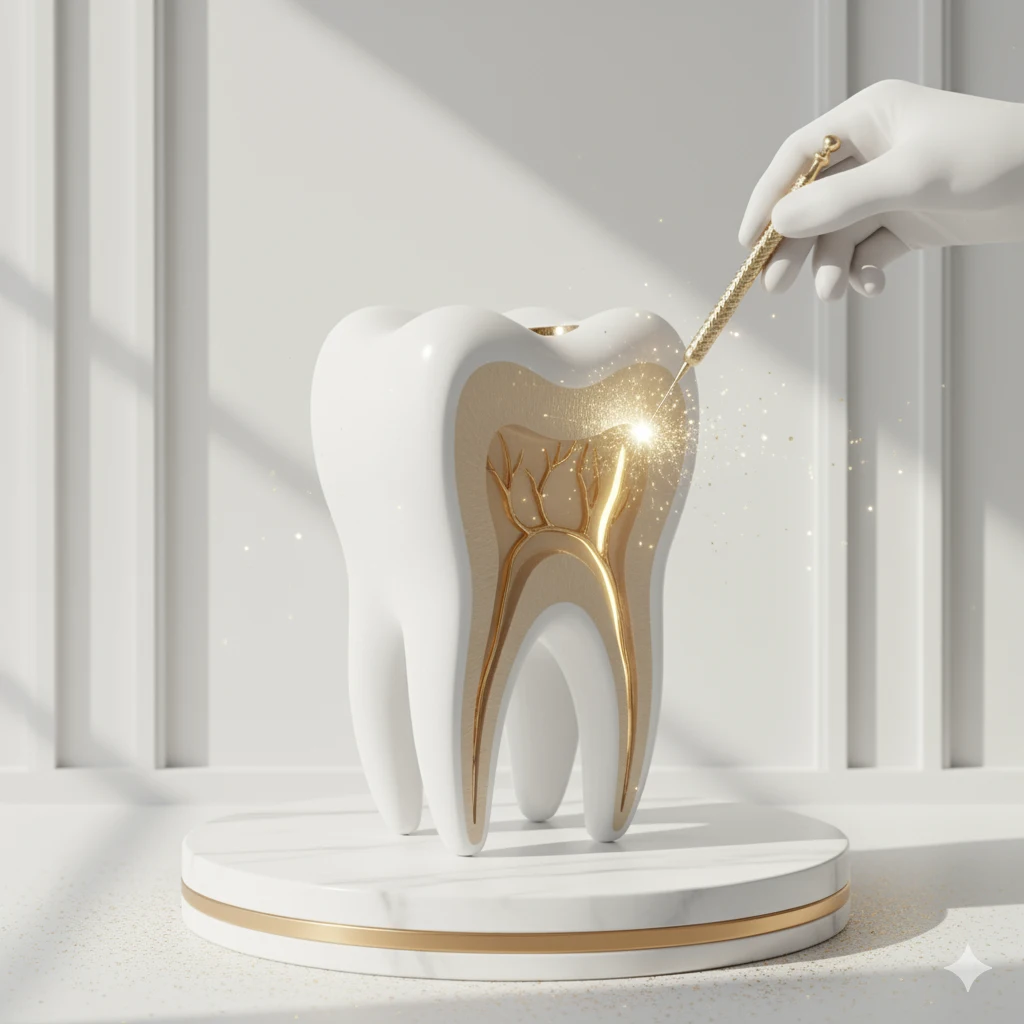
Endodontics, commonly known as root canal treatment, diagnoses and treats diseases of the pulp (nerve-vascular bundle) inside the tooth and the tissues surrounding the root. In Valinor The goal is not only to relieve pain but also to keep the natural tooth healthy, functional and aesthetically pleasing for many years.
Our approach: minimally invasive – biomimetic – microscope-assisted – digitally planned treatment.
1) Introduction to Endodontics: Anatomy & Diseases
- Pulp: Living tissue beneath enamel and dentin that provides sensitivity and defense.
- Root canals: The number and form of root canals vary depending on the tooth; variations affect the treatment.
- Major diseases
- Reversible pulpitis: Short-term pain with cold; may improve with filling.
- Irreversible pulpitis: Prolonged/spontaneous pain; root canal treatment required.
- Pulp necrosis: Death of the nerve; infection and apical lesion may develop.
- Apical periodontitis: Inflammation at the root tip; pain on chewing, sometimes swelling.
2) Diagnosis & Planning (Correct Diagnosis = Longevity)
- Clinical tests: Cold/heat, EPT (electrical vitality), percussion/palpation, bite test (biting), transillumination.
- Radiology: Periapical/bitewing; low-dose CBCT in complex anatomy.
- Digital recording: Intraoral photo, non-contact measurement with scanner, occlusion analysis.
- Risk analysis: Systemic conditions (DM, anticoagulants), bruxism, hygiene, diet.
- Treatment roadmap: Endodontic treatment + restorative plan is designed in an integrated manner.
3) Pain Management & Anesthesia
- Anesthesia options: Infiltration, block, buffered, intraligamentary, intraosseous, intrapulpal.
- Difficult cases (acute pulpitis): Combinations of buffered + additional techniques.
- Sedation (in suitable patients): Anxiety control; safe and controlled approach.
- Emergency protocols: Pulpotomy/pulpectomy, incision–drainage.
4) Isolation, Visualization & Infection Control
- Rubber dam: Isolation from saliva, aerosol control, instrumentation safety.
- Microscope/loupe: Extra channels, cracks, perforations become visible.
- Instrument & area sterilization: High standardization; minimizing the risk of cross-contamination.
5) Stages of Root Canal Treatment (Golden Protocol)
- Access cavity (conservative access)
- Providing glide path and skate
- Working length: Apex locator + radiographic verification
- Shaping: Rotary/reciprocating, crown-down or hybrid technique
- Irrigation–disinfection:
- Main solution: (Protocol determined in the clinic)
- Chelation: EDTA (smear layer removal)
- Alternative: (Depending on the situation) CHX – concurrent use rules are observed
- Activation: Ultrasonic/sonic, apical negative pressure, photonic activation
- Medicament (in selected cases): Calcium hydroxide, etc.
- Obturation (canal filling):
- Cold lateral
- Hot vertical
- With carrier
- Single cone & bioceramic sealer (hydraulic condensation)
- Coronal sealing: Immediate temporary/permanent restoration
- Final restoration: Composite – inlay/onlay – veneer (ferrule principle)
6) Irrigation and Disinfection: Fine Tuning
- Purpose: To remove bacteria, biofilm, and smear layer; to access complex anatomy.
- Activation: Ultrasonic/sonic tips, apical negative pressure, photonic activation (flow augmentation with laser-induced photonic wave).
- Safety: Prevention of solution overflow, appropriate concentration/time, irrigation needle control.
7) Special Situations & Difficult Scenarios
- Canal calcification: Calcified access tract under microscope; patience and microtechnique.
- Instrument fracture: Bypass/extraction/top closure – risk–benefit analysis.
- Pathway deviation/transport: Control with irrigation & sealing; surgery if necessary.
- Perforation: Early recognition & bioceramic repair.
- Open apex: Apexification (bioceramic apical plug) or regenerative endodontics.
- Endo–perio lesions: Source separation + integrated periodontal therapy.
- Crack/FR:
- Craze line: No treatment required
- Fractured cusp: Repair/coating
- Cracked tooth: Endo + cuspal coverage
- Vertical root fracture: Prognosis is poor; extraction may be considered.
8) Revision (Re-Root Canal Treatment)
- Indication: Persistent pain/lesion, inadequate filling, new caries, leakage.
- Steps:
- Removal of old filling with a combination of solvent-ultrasonic-mechanical
- Microtechniques for post/core/carrier–silver cone removal
- Extensive disinfection + modern obturation
- Purpose: To save the natural tooth as an implant alternative.
9) Apical Surgery (Micro-Surgery)
- Apicoectomy: 3 mm resection of the root tip + retro-preparation.
- Retro-filling: Apical sealing with bioceramic material.
- Indications: Persistent lesion, suspicion of cyst, inability to remove the post, anatomical obstacles.
- Advantage: Long-term retention without tooth extraction.
10) Trauma Endodontics & Resorptions
- Luxation injuries: Concussion/subluxation/extrusion/lateral/intrusion – pulp vitality monitoring; endo if necessary.
- Avulsion: Replantation + splint; endo plan according to root development.
- Resorption
- Internal: Inside the canal; endo is successful in early diagnosis.
- External inflammatory: Trauma/infection; disinfection and sealing are essential.
- Replacement (ankylosis): Prognosis and growth effect are evaluated.
11) Endodontics in Children and Young Patients
- Pulpotomy (milk tooth/immature): Vital treatment with bioceramic materials.
- Pulpectomy: Resorbable filling material in the primary tooth.
- Apexogenesis: Completion of root development with vital pulp.
- Apexification (apical plug) / Regenerative endodontics: Bleeding induction + biomimetic sealing.
12) Restorative Integration & Longevity
- Coronal sealing: Critical to success.
- Cuspal coverage: Reduces fracture in posteriors with weak walls.
- Endo-crown: Indication especially in cases of extensive substance loss + short roots.
- Occlusion adjustment: Reduces postoperative pain and fracture risk.
13) Systemic Conditions & Medications
- Anticoagulants: Generally continued in non-extraction procedures; inter-physician coordination if surgical.
- Pregnancy: 2nd trimester is ideal; emergencies are planned at all times, safe anesthesia/radiology protocol.
- Diabetes/immunosuppression: Infection control, glycemic balance monitoring.
- Antibiotics: Indication only in cases of systemic involvement (fever/edema/cellulitis) etc.; compliance with resistance policies.
Valinor Dental Clinic Difference
- Microscope-assisted endodontics & digital planning
- Advanced irrigation activation and bioceramic sealing
- High standards in rubber dam and sterilization protocols
- Restorative–prosthetic–surgical integrated approach
- Painless, comfortable, transparent process management
Frequently Asked Questions (FAQ) – Endodontics
- What is root canal treatment?
It is the removal of the infected/inflamed pulp inside the tooth, disinfection of the canal and three-dimensional filling with biocompatible materials. - Why is it necessary?
To stop pain, infection and tissue loss and preserve the natural tooth in the mouth. - What if I don't get root canal treatment?
As the infection progresses, it can lead to abscesses, facial swelling, and tooth loss. - Is it painful?
Painless with local anesthesia and modern techniques. - How many sessions?
Simple cases need one session, resistant infections need 2–3 sessions. - Success rate?
Very high with the right protocol; coronal seal and hygiene are decisive. - Is a root canal treated tooth alive?
There is no pulp vitality; the tooth remains functional in the mouth. - Will it be fragile?
Yes, it is strengthened by cuspal coverage, albeit slightly. - Will aesthetics be affected?
A natural appearance is achieved with internal whitening/aesthetic restoration of the front teeth. - Is it possible to have a root canal instead of an implant?
Preserving the natural tooth, if it can be saved, is the priority. - What tests are performed?
Cold/heat, EPT, percussion, palpation, bite test. - Is CBCT necessary?
No; useful in complex anatomy, used selectively. - Are X-rays harmful?
It is safe when used low dose and with protection. - I have pain but the x-ray is normal?
It may not be visible in the early stages; it is clinically determinative. - Will my other tooth be affected too?
Infection progresses locally; hygiene and controls are important. - What if the anesthesia doesn't work?
Additional techniques such as buffer and intraosseous/intrapulpal are applied. - Is sedation necessary?
It can be evaluated in high anxiety. - I have allergies, what happens?
Alternative anesthetics and tests are planned. - I have a heart rhythm disorder?
Safe planning with appropriate dose/agent selection and consultation. - Are long sessions difficult?
We use support pillows, breaks, and gentle positioning. - Why is a rubber dam mandatory?
For sealing, safety and disinfection. - Is a microscope necessary?
Significantly increases success in difficult anatomies. - Can additional channels be found?
Yes; it is often detected with a microscope. - Can the crack be seen?
With transillumination + microscope. - Can instrument fractures be prevented?
Risk is mitigated; if broken, there is a management protocol. - Is Rotary better or in hand?
Case-by-case; rotary/reciprocated in most cases. - What is glide path?
The slippery slope to safe instrumentation. - Why EDTA?
Removes the smear layer and deepens disinfection. - What if irrigation overflows?
With protocols, the risk is greatly reduced; complications are rare. - Is a laser necessary?
Helpful in difficult biofilm cases; if not, success is possible. - What is calcium hydroxide used for?
Antibacterial, promotes tissue healing. - Root canal filling material?
Gutta-percha + sealer (including bioceramic options). - Is the single cone technique safe?
Yes, with appropriate shaping + bioceramic sealer. - Is hot vertical better?
Provides three-dimensional adaptation; case-by-case decision. - Is film necessary after filling?
Yes, for quality control. - Success in calcified canal?
High with microscope + patience + microtechnique. - What if the tool breaks?
Bypass/excision/top closure; prognosis is case specific. - What if there was a perforation?
Good results are achieved with early detection and bioceramic repair. - Open apex?
Apexification or regenerative endodontics. - Endo–perio lesion?
Combined with source separation + periodontal treatment. - When is revision necessary?
Pain, lesion, inadequate filling/sealing. - Revision success rate?
It is high with the right protocol. - Is it possible while there is a post?
It can be dismantled with microtechniques; risk/benefit analysis is performed. - Will the silver cone/carrier filling come off?
In most cases, yes. - Revision or implant?
If the tooth can be saved, revision is the priority.
I) Apical Surgery
- What is apicoectomy?
Surgical resection of the root tip + retro filling. - When is it done?
Revision failure, post-removal impossibility, anatomical obstacles. - Recovery time?
Usually 1–2 weeks. - Is swelling/edema normal?
The first days may be limited. - Success rate?
It is high in appropriate indications. - What to do after avulsion?
Store the tooth in milk/serum, apply immediately. - Post-replant root canal?
It is planned according to root development. - Can internal resorption be treated?
Yes, with endo in early diagnosis. - External resorption?
Infection control + sealing is essential. - What if there is ankylosis?
Special management is required during the growth period. - Can a root canal be placed on a milk tooth?
Pulpectomy/pulpotomy is performed. - Is it painful?
Comfortable with age-appropriate anesthesia. - What is apexogenesis?
Completing root development with living pulp. - Apexification?
Bioceramic apical barrier. - Regenerative endodontics?
Approach to restart root development in immature teeth. - Immediate filling after root canal?
Yes, coronal sealing is critical. - Is coating necessary?
Yes in weak posteriors; onlay/composite in small defects. - What is Endo-Crown?
Single piece restoration in cases of extensive material loss. - Is occlusion adjustment necessary?
It reduces pain and fracture risk. - How long does it last?
With hygiene and restoration quality for years. - Am I taking anticoagulants?
Generally, non-extraction procedures continue; team coordination in surgery. - I am pregnant, can this be done?
The second trimester is ideal; it can be safely planned in the emergency room at any time. - Am I diabetic?
Glycemic control + infection management. - Are antibiotics necessary?
Only systemic findings; routine endo is not required. - Am I at risk of allergies?
Material/anesthetic alternatives are available. - How long does the pain last?
Mild–moderate 24–72 hours; if increased, contact clinic. - What if there is swelling?
Rarely; controlled, intervened if necessary. - Color change?
It is corrected by internal whitening of the front teeth. - Eating/chewing?
Be careful on the first day; avoid hard foods. - Return to sports?
In most cases the same/next day. - The tool is broken, can the tooth be extracted?
In most cases it is not necessary; it can be managed. - Was there a perforation?
Good prognosis with bioceramic repair. - Flare-up (sudden pain/swelling)?
Irrigation–drainage–medication administration. - The numbness hasn't gone away?
It usually resolves within hours; if it lasts longer, get checked. - Teeth associated with the sinus?
Radiological–clinical evaluation and gentle protocol. - Dullness in my front teeth after root canal?
Internal whitening + aesthetic restoration. - Will my hot/cold sensitivity go away?
Yes, once the infected pulp has been removed. - Chewing pain?
It may be the first few days; the occlusion adjustment will be more comfortable. - Bad smell/taste?
The infection disappears with cleaning. - Will my speech be affected?
No. - Will the lesion shrink?
In successful endo, the bone heals over time. - When is the follow-up x-ray?
Every 6–12 months. - Why does revision fail?
Anatomy, leakage, restoration delay, etc. - When is surgery?
In selected cases where revision is possible/unsuccessful. - When is the shooting?
Fracture/prognosis-free root, advanced mobility, etc. - How often to check?
6–12 months. - Is a night plate necessary?
Recommended for bruxism. - Dietary effect?
Reduce sugar/acid frequency. - Should I use oral irrigator?
It can support interface cleaning. - Smoking effect?
It may negatively affect healing. - Prices?
Depending on the difficulty of the case, the number of channels, and the need for advanced techniques. - Duration of treatment?
Simple one session; 2–3 sessions in complex cases. - Is there a warranty?
Compliance with the written care protocol; long-term follow-up is essential. - Cancel an appointment?
To protect planning, advance notice is requested. - The Valinor difference?
The microscope–digital–biomimetic triad and the elegant patient experience. - Is same-day treatment possible?
In appropriate cases, yes. - Before flight/travel?
Postponement in the acute phase is not a problem in stable cases. - Athlete/performance impact?
Painless teeth improve performance. - Photo/video recording?
For documentation and educational purposes, please confirm.
Valinor Dental Clinic'’Endodontics is not just a “root canal treatment”; it is a refined treatment philosophy that preserves the value of natural teeth.
We are here to provide painless, safe, long-lasting results with a microscope-assisted, digitally planned and biomimetic approach.
Site contents are for informational purposes only and do not constitute advice.